

The safe moisture content for baling hay in Australia depends on the bale type: 16 to 18 percent for small square bales, 14 to 16 percent for large rounds, 12 to 14 percent for large squares, and below 12 percent for export hay. Those are the ranges Agriculture Victoria recommends for safe storage, and the pattern behind them is simple: the bigger and denser the bale, the drier the hay needs to be, because dense bales trap heat and moisture in their core with nowhere for it to escape.
Get this wrong by even a few points and the cost is real. Two to three percent above the maximum and hay starts losing dry matter and feed value to plant respiration and mould. Go four or more points over and the stack can heat toward spontaneous combustion, which the CFA identifies as the leading cause of haystack fires in Victoria. One damp bale is enough to ignite an entire stack. Here is how to hit the right numbers, how to test properly, and what to watch after the hay is in the shed.
Safe Baling Moisture by Bale Type
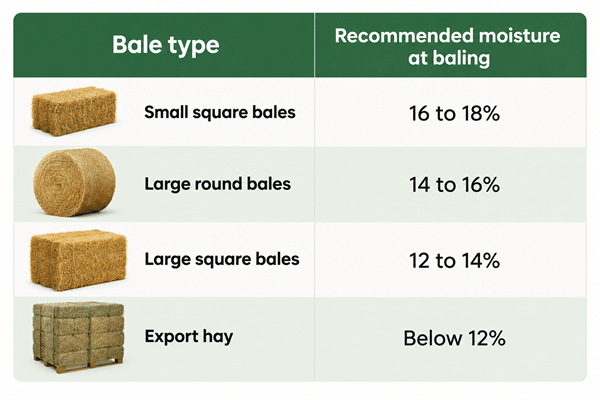
Source: Agriculture Victoria recommended moisture contents for safe hay storage.
Why the differences? A small square is light and loosely packed enough for some air movement, so it tolerates a little more moisture. A large square is pressed hard, weighs up to 600 kg, and its core may sit at the centre of a stack for months. Any excess moisture in there feeds microbial activity, and microbial activity generates heat. That is also why bale density is a moisture decision as much as a baler setting: if you run a bale density controller and press dense, heavy bales for freight efficiency, your moisture discipline has to be tighter to match.
How Wet Hay Turns Into a Fire
Spontaneous combustion is not bad luck, it is biology and chemistry running a predictable course. Hay baled too wet, or hay that was never fully cured, is still biologically active. Bacteria and fungi grow in the moist material and their activity generates heat. In a loose pile that heat escapes. In a dense bale in the middle of a tight stack, it accumulates. Once the interior climbs past roughly 55 degrees, flammable gases can be released, and with oxygen present the stack can ignite from the inside. Most hay fires occur within the first six weeks of baling, which is exactly the window when new hay is sitting freshly stacked in the shed.
The trap that catches experienced operators is hidden moisture. A windrow can test dry while the nodes and seed heads inside the leaf sheath are still green, especially in cereal hay. That is why Agriculture Victoria and the CFA both stress testing plant nodes and heads directly, and making sure hay is fully cured, meaning dead and dry, before the baler goes in. Dew, moist ground under the windrow and rain-affected patches all push individual bales over the line even when the paddock average looks fine.
Testing Moisture Properly
A hay moisture meter is cheap insurance against losing a season’s work. Use it the way the fire authorities recommend rather than as a single-poke formality. Test repeatedly throughout baling, not just at the start, because moisture shifts through the day as dew burns off and returns in the evening. Probe multiple bales and multiple spots per bale, and test nodes and heads, not just leaf. Treat any reading above your target range as a stop signal, not a rounding error.
Timing through the day matters as much as the meter. Hay picks up moisture overnight and holds it into the morning, so early starts on dewy mornings routinely bale hay several points wetter than the meter read the previous afternoon. The reliable window is once the dew has fully burned off, and in humid or overcast weather that window can be shorter than the paddock is big, which is another reason moisture checks continue through the day rather than happening once. It is better to bale into the dew, as when it’s coming in the leaf gets moisture. When its coming out of the dew, the moisture is stuck in the stem and leaf loss can occur. Cured hay can also go backwards with a heavy dew. Gazeeka moisture meters offer better options with markings too.
If you buy hay in, ask for its baling history and moisture readings. A stack fire does not care whether the wet bale was yours or the seller’s.
Monitoring the Stack After Baling
For the first six to eight weeks, treat a new stack as something you check, not something you forget. Agriculture Victoria’s warning signs of a heating stack are specific: steam rising off the stack, unusual odours like caramel, pipe tobacco or a musty burning smell, mould on or inside bales, condensation or corrosion on the underside of roofing iron, and slumping or deformation in parts of the stack.
Regularly monitoring stored hay for signs of heating is important, particularly in the weeks after baling. Where practical, a steel probe or purpose-built hay temperature probe can be used to check temperatures within the stack. Pay attention to unusual heat, condensation, a strong or unusual smell, or other signs that the hay may be heating. If there are concerns about excessive heat, seek professional advice before moving or opening the stack, as introducing additional oxygen can increase the risk of fire.
Sensible stack design limits the damage if something does go wrong. The CFA recommends splitting hay across several smaller stacks or locations rather than one giant stack, and leaving air space between the top of the stack and the shed roof for circulation. Both of those also make routine monitoring easier.
Moisture Discipline Protects More Than the Shed
Even when wet hay never ignites, it costs you. Heating burns dry matter and energy value, mould makes hay unpalatable or dangerous to feed, and water-damaged bales are effectively a write-off for livestock. The same moisture rules that prevent fires also protect feed quality, which is why export buyers specify below 12 percent and back it with testing.
Handling plays a part too. Bales that are made at the right moisture, then moved gently and stacked tight and square, store best. Jadan’s Accumulator and Small Bale Grab keep small squares moving from baler to shed without rough handling, and the Verti-Stack, Big Bale Stacker and Unistack do the same for large squares, cutting stacking time so hay gets under cover faster when weather threatens. Getting bales off the paddock quickly matters, but only after they are dry enough to store; speed is no substitute for moisture. Once the hay is in, our guide to storing square bales covers keeping it in condition, and preparing your machinery before hay season helps make sure nothing forces you to bale in a rush.


