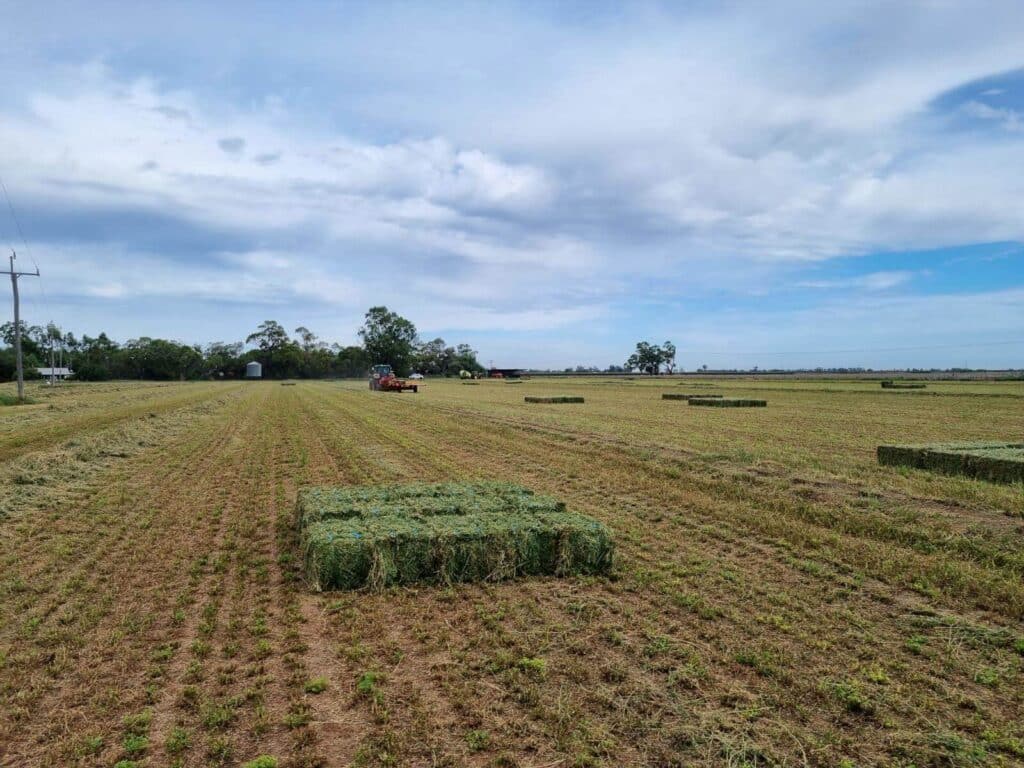
Choosing the Right Storage Location
Whenever possible, always store hay in sheds or barns. If undercover storage is not available, consider the following points when storing outside.
Prioritise Good Drainage. Drainage should be the top priority when selecting a storage site. Avoid low-lying areas, drainage lines, or locations where water collects after rain. Slightly elevated ground with a gentle slope helps keep moisture away from the base of the stack and reduces spoilage.
Maximise Sunlight and Airflow. Choose a location with good sun exposure and natural airflow to help bales dry quickly after rain. Open, well-ventilated sites reduce moisture retention and minimise the risk of mould and deterioration.
Keep Bales Away From Trees. Trees and dense vegetation can trap moisture, block airflow, and attract rodents. Falling leaves and debris can also hold moisture against bales. Maintaining at least 15 metres of open space from tree lines is generally recommended.
Ensure Easy Equipment Access. Storage areas should allow easy access for tractors, bale grabs, and other handling equipment. Well-planned access routes make it easier to rotate stock, move bales when needed, and maintain efficient storage practices throughout the year.

How To Avoid Spoilage From Ground Contact
Storing square bales directly on bare soil is one of the most common and costly mistakes in hay storage. Moisture wicks up from the ground into the bottom bales, creating a soggy, mould-prone base. With square bales, the problem is exacerbated by the entire flat bottom face sitting flush against the ground. There’s no curved surface to limit contact.
Here’s what you can do to avoid that.
Gravel pads are the gold standard. A bed of crushed stone or gravel 100–150 mm deep provides drainage underneath the stack and prevents moisture wicking. Gravel pads last for years, need minimal maintenance, and pay for themselves quickly in reduced spoilage. If you’re establishing a permanent storage yard, gravel is worth the initial investment.
Pallets and treated timber offer a lower-cost alternative. They don’t drain as well as gravel and will decay over time, but they break ground contact and significantly reduce bottom spoilage compared to bare earth. Used pallets are often available cheaply and can be replaced as needed, and they suit the flat base of a square bale stack neatly.
Plastic Sheets on the ground. Plastic sheeting, like concreter’s plastic or old tarps, can provide a barrier between the ground and the hay, and will help prevent spoilage.
Concrete pads are ideal for permanent covered storage. They’re easy to clean, drain well, and give you a firm, level base for high stacks. Inside a shed, a concrete floor maximises the benefit.
Even a small amount of elevation and separation from direct soil contact makes a noticeable difference to dry matter retention.
Stacking and Airflow
This is where square bales really differ from rounds. Their flat faces let them stack tightly, precisely, and high, which is a big advantage for storage density and transport. But those same flat faces trap moisture wherever bales meet, and flat tops collect water rather than shedding it.
Stack on a well-drained, level base. Square bales stack stably only on firm, level ground. A gravel or concrete pad keeps the bottom course out of the wet and gives you a safe foundation for height.
Peak or cap the top of an outdoor stack. A flat-topped stack left in the open is a water trap. If bales must live outside, finish with a sloped top course or a tarpaulin pitched to shed rain, so water runs off rather than soaking down through the stack.
Leave space between separate stacks. Tucking stacks tightly side by side traps moisture and blocks the airflow that dries surface dampness. Leave roughly 450–600 mm between stacks for air to move and make it easier to inspect and shift bales. Within a stack, bales can sit flush.
Orient stacks to the prevailing wind and sun. Running the long axis of the stack to catch airflow and sun helps surfaces dry between weather events and reduces long-term shading.

Covered vs. Uncovered Storage
For square bales, this is less of a debate than it is for rounds. Because square bales can’t shed water, covered storage is the strongly preferred option. For small square bales, it’s close to essential.
Covered storage is worth it for almost any quality hay. A traditional hay shed, a fabric-covered structure, or a simple pole barn offers the maximum protection. If you’re producing or buying hay with high protein content for dairy cattle, horses, or show animals, even minor spoilage justifies the cost. A 5% loss on premium hay can exceed the annual cost of a modest shed. Small square bales in particular hold their colour, leaf, and feed value far better under cover.
Tarping is the minimum for outdoor square bales. If covered storage isn’t available, a good-quality tarp pitched to shed water is the next best thing. Cover the top and upper sides while leaving the base open for airflow, and weight or tie it down securely. An uncovered, flat-topped square bale stack in a wet climate will deteriorate fast.
Plastic wrapping suits high-moisture hay. Individually wrapped or tube-wrapped large square bales (silage) seal each bale and let you bale at higher moisture than dry hay allows. It adds cost per bale but is widely used where the weather won’t cooperate for dry hay.
Efficient Handling During Storage
Good storage starts with careful, efficient handling. Bales that are dropped from height, dragged, or stacked roughly lose their shape and shed strings. A burst or odd-shaped square bale stacks poorly, traps water, and is harder to feed out. Gentle mechanical handling also preserves the leaf and reduces the leaf shatter that costs you feed value.
Matching your handling gear to the job makes a real difference to daily efficiency and to how well your stacks hold up. Jadan’s range is built specifically for square bales:
- The Small Bale Grab attaches to your front-end loader, telehandler or forklift and lifts, moves, and stacks whole packs of small square bales. It uses no straps, chains, or manual stacking. The mechanical grip reduces leaf loss compared with handling by hand, and it pairs directly with the Accumulator.
- The Accumulator tows behind your small square baler and gathers bales into tidy packs as they leave the chamber. Then, it slides them gently to the ground, ready for pickup. This keeps your paddock neat and protects bale quality.
- The Big Bale Stacker lets a single operator collect large square bales straight from the paddock. It stacks them neatly, in stacks of six or four, depending on bale size, with no extra machinery and less strain on your loader.
- The Verti-Stack works behind most large square balers, accumulating and stacking three to four bales high as you bale. Field testing shows stacking times reduced by up to 50%, with fewer passes, lower fuel use, and less wear on tractors and loaders.
- The UniStack stacks up to 14 large square bales directly from the paddock, built for larger operations chasing high output with minimal downtime.
You can see how farms across Australia have cut handling time and labour with these systems in Jadan’s case studies. Having your equipment serviced and ready before the season starts means you can move and stack bales efficiently at peak harvest, when delays cost the most.
Rotation and Inventory Management
Good storage habits include a rotation system. First in, first out (feeding the oldest bales first) stops hay ageing in storage longer than necessary and helps you use up less-than-ideal bales before they deteriorate further.
Mark stacks or rows by cutting date, so you know which bales are oldest. If you have bales from multiple cuttings or quality grades, keep them separate in storage so you can match feed to your livestock’s needs.
Walk your storage area regularly, especially after heavy rain. Catching a problem early (a slipped tarp, water pooling on a flat-topped stack, dampness building between stacks) can save bales that would otherwise be lost.

Frequently Asked Questions
- How long can square bales be stored outdoors before significant spoilage occurs?
It depends heavily on coverage. Tarped large square bales on a well-drained base can be held outdoors for several months with acceptable losses. Uncovered square bales, especially small squares, can suffer heavy spoilage within weeks in wet conditions, because their flat surfaces hold water rather than shedding it. Covered storage or plastic wrapping extends usable life well beyond a single season.
- What is the maximum moisture level at which square bales should be stored?
For dry storage, square bales should generally be baled and stored at or below 15-18% moisture. Densely packed small square bales stacked in a shed are particularly prone to heating and, in extreme cases, spontaneous combustion if baled too wet, so erring on the drier side matters. If you need to bale at higher moisture, plastic wrapping for baleage is the safer option.
- Why do square bales spoil faster outdoors than round bales?
A round bale’s curved surface sheds rain, so water runs off. A square bale has a flat top that pools water and flat faces that absorb it, with no natural runoff. That’s why covering, whether a shed or at least a tarp, matters more for square bales than it does for rounds.
- How high can square bales be stacked?
Square bales stack far higher and more stably than round bales because of their flat, interlocking faces. In a shed, small square bales are routinely stacked many tiers high; large square bales are commonly stacked three to six high outdoors and higher under cover. The limits are the stability of your base, the reach and the safety of your handling equipment. Always stack on firm, level ground to keep the stack from becoming a fall or collapse hazard.
- Is it worth building a dedicated hay storage structure?
For square bales, the answer is often yes, even more so than for rounds, since they need protection from rain to perform. The rule of thumb: if the reduction in annual spoilage exceeds the annualised cost of the structure, it’s worthwhile. For operations storing a couple of hundred bales of quality hay a year, a dedicated shed frequently pays for itself within a few seasons through reduced losses and better feed quality.
Start Protecting Your Hay Investment Today
Reducing spoilage is one of the highest-return improvements most operations can make, and much of it comes down to a better location, separation from the ground, a cover over the top, and consistent management habits. For larger gains, the right handling equipment makes moving, stacking, and feeding bales faster and easier across the whole operation.
Browse Jadan’s full range of square bale handling equipment, including grabs, accumulators, and stackers, to find the tools that match your operation. Whether you’re running a small farm or scaling up a larger commercial setup, the right system pays for itself in time saved and spoilage prevented.
Have a question about handling or storing square bales? Contact our team today. We’re here to help you find the right solution for your operation.