Understanding the Formats
Before comparing, it’s worth knowing what you’re actually dealing with.
Round bales are the large cylindrical bales most commonly associated with modern beef cattle operations. They typically weigh between 363 and 680 kilograms and are produced by a round baler that continuously feeds and compresses hay into a rolling cylinder. They’re designed to be handled with mechanised equipment; a tractor-mounted bale spear or front-end loader attachment is essentially required for anything heavier than a few hundred kilograms.
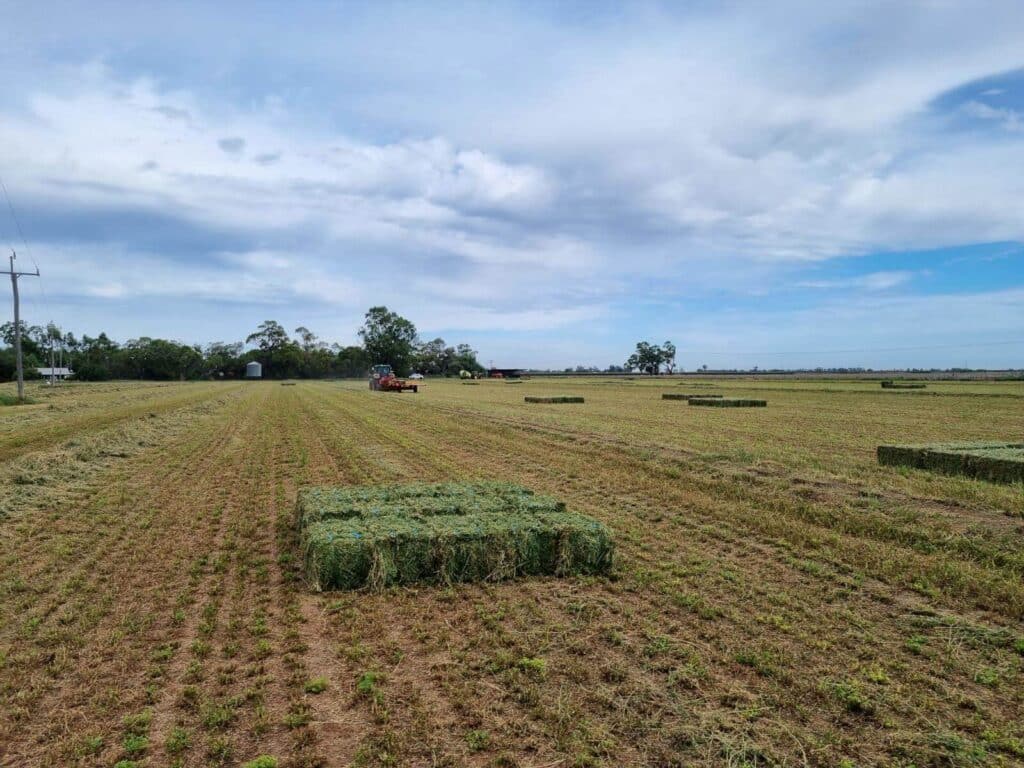
Square bales come in two very different sizes. Small square bales (also called “two-tie” bales) weigh between 18 and 34 kilograms and are the classic hand-stacked bale that most people picture. Large square bales (four-string to eight-string) weigh from 272 to 907 kilograms, depending on configuration and are handled with the same kind of equipment as round bales. When most people debate “round vs. square,” they’re comparing round bales to small square bales for convenience but the large square bale is also worth considering for commercial operations.
Labour and Handling
This is often the deciding factor for most operations.
Small square bales were traditionally stacked by hand, which makes them accessible without specialised equipment but expensive in time. Moving, stacking, and feeding small squares takes significantly more physical effort than operating a tractor with a bale spear. If you’re running a large number of animals or operating with limited help, the daily labour of small square bale feeding adds up quickly.
Both round and square bales require the right equipment to move efficiently, but they’re not equal when things don’t go to plan. A 500-kilogram round bale is immovable without a front-end loader and the correct attachment. Square bales, by contrast, give you flexibility: mechanised handling when you have the equipment and a manual fallback when you don’t. As covered in our guide to bale handling and choosing the right equipment,, a good bale feeder or hay fork designed for square bales can make feeding straightforward.
Feeding Efficiency and Waste
How much of what you buy actually reaches your animals is a critical factor in the true cost of any hay format.
Large square bales placed in hay feeders reduce waste considerably compared to simply dropping a bale in a field and letting animals eat freely. Without a hay feeder, cattle will lie on, urinate on, and trample a significant percentage of a bale before finishing it. Research suggests free-choice bale feeding without feeders can result in waste rates of 30% or higher. A quality hay feeder can bring that waste rate down to under 10%, dramatically improving your cost per kilogram of hay actually consumed.
Small square bales produce less waste in some feeding scenarios. With horses, for example, or in situations where animals are fed in stalls or small pens, small squares allow precise portion control and minimal trampling. Horses in particular tend to do well on small squares because you can control exactly how much they receive.
Large square bales tend to be the most efficient format for commercial operations feeding large numbers of animals. Their density and shape allow better stacking, more efficient transport, and predictable weight per unit.
Storage Requirements
Storage has a major impact on which format makes practical sense for your situation.
Small square bales require covered, stacked storage. They don’t shed rain effectively and will spoil quickly if left outdoors without protection. A hay barn or covered structure is essentially necessary. Covered storage produces minimal spoilage but it requires infrastructure investment.
Large square bales are more space-efficient for covered storage. You can fit more tonnage in the same footprint, which matters when building or barn space is limited.
Round bales can be stored outdoors with net-wrapped and proper site selection, though some spoilage risk is always present. If you have covered storage available, large square bales are the better option.
Equipment Costs and Requirements
The equipment picture varies significantly between formats.
Small square bale production and feeding require a small square baler, an accumulator and a grab for stacking. On the feeding end, no specialised equipment is needed; bales can be fed by hand, tossed into mangers, or broken open in feeders.
Round bale production requires a round baler (a larger investment than a small square baler) and a tractor capable of handling the baler’s power requirements. On the feeding side, you’ll need at a minimum a front-end loader with a bale spear attachment. The equipment dependency at every stage makes round bales a less flexible choice for smaller or mixed operations.
Purchasing hay rather than producing it changes the situation. If you’re buying rather than making hay, the production equipment question is irrelevant; you simply need the right handling and feeding equipment for the format you’re buying. Browse Jadan’s hay handling equipment to find what suits your setup.
Making sure your equipment is ready for hay season before harvest begins is critical, regardless of which format you choose. Breakdowns during cutting or baling are costly in any system.

Animal Type: Does It Matter What You’re Feeding?
Yes, significantly.
Horses are traditionally fed small square bales because they need precise ration control to avoid obesity, colic, and metabolic issues. Small squares allow you to feed two biscuits twice daily with precision that’s difficult to replicate with a 500-kilogram round or large square bale. For larger equine operations, round bales used with slow-feeder nets can work, but precise daily ration control remains easier with squares.
Beef cattle operations work well with either square or round bales, but square bales offer better flexibility and control. This is particularly important for smaller herds or mixed operations where not every feeding day involves a tractor.
They’re efficient at self-feeding from ring feeders, they’re forgiving about hay quality variations across a bale, and the scale of round bales matches typical beef cattle herd sizes. The mechanised handling aligns with how most cattle operations already work.
Horses are traditionally fed small square bales, and for good reason. Horses need precise ration control to avoid obesity, colic, and metabolic issues. Small squares allow you to feed two biscuits flakes twice daily with precision that’s difficult to replicate with a 500-kilogram round bale. However, large operations with multiple horses are increasingly using round bales fed through slow-feeders or hay nets, which can work well when managed carefully.
Sheep and goats are typically better served by small squares or precision feeding, though this depends on herd size. A small flock can be efficiently managed on small squares without any specialised equipment.
Dairy cattle on high-production rations often benefit from the consistency of large square bales, which can be sampled for nutritional analysis more accurately than round bales.

Cost Comparison
Hay prices vary enormously by region and season, but some general cost principles hold across most markets.
Round bales typically cost less per tonne than small square bales because they’re faster and cheaper to produce and carry lower handling premiums. But that upfront savings come with trade-offs: without the right feeding equipment, waste rates on round bales can offset the price difference quickly.
Small square bales carry a price premium that reflects the labour involved in their production and the convenience they deliver. For horse owners, small hobby farms, or operations without specialised equipment, that premium pays for itself through better portion control, lower waste, and no equipment dependency.
Large square bales generally sit between the two on cost per tonne, while offering the stacking and storage efficiency advantages of the square format.
Making the Decision: A Simple Framework
If you’re still unsure after working through the comparisons above, here’s a practical decision framework:
Choose round bales if: You have outdoor storage or you’re operating at scale with limited labour.
Choose small square bales if: You’re feeding horses or a small number of animals, you need precise portion control, you lack specialised equipment and rely on manual feeding, or you have covered barn storage and want minimal spoilage.
Consider large square bales if: You’re running a medium to commercial-scale operation, you have the forklift or spear attachment capacity to handle them, and you want the storage efficiency advantages over round bales.

Frequently Asked Questions
How many animals can one large square bale typically feed, and for how long?
One large square bale can generally feed 10 to 15 beef cattle for 1 to 2 days if they are entirely dependent on it for their daily feed, or 3 to 5 days if they have access to pastures as well. For a single large animal like a horse, the same bale can last anywhere from 1 to 3 months, depending on the animal’s weight, the bale’s density and pasture availability.
Are large square bales better than round bales for storage?
Large square bales offer better space efficiency in covered storage because they stack tightly and maximise available barn space.
What equipment do I need to start feeding large square bales?
At a minimum, you will need a tractor equipped with a front-end loader capable of safely lifting the bale weight, along with a bale spear attachment. Together, these tools create a practical and cost-effective bale feeding system.
Does bale size affect nutritional quality?
Bale size itself does not directly influence nutritional quality. Hay quality is primarily determined by factors such as forage species, maturity at harvest, cutting timing, and curing conditions. However, larger bales can be easier to sample for laboratory testing, making nutritional analysis more convenient for operations with specific feeding requirements, such as dairy farms or performance livestock programs.
Find the Right Equipment for Your Operation
Whether you’re switching formats, scaling up, or just getting started, having the right bale handling and feeding equipment makes a daily difference. Browse our complete range of hay handling equipment & spare parts to find what fits your tractor and your operation.
Not sure what you need? Get in touch with our team. We work with operations of all sizes and can help you put together the right setup for your animals, your equipment, and your budget.