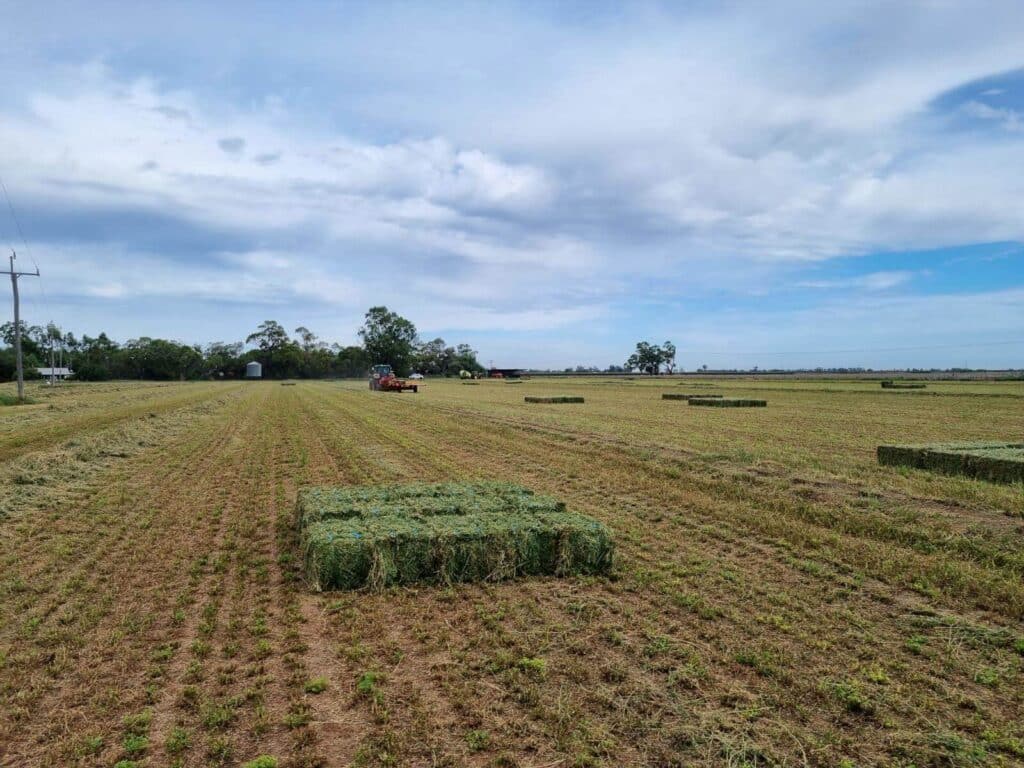
How Much Does a Bale of Hay Weigh in Australia and What You Need to Lift It

An Australian small square bale of hay weighs roughly 20 to 30 kg, a large square bale ranges from about 270 kg to 800 kg depending on its dimensions, and a round bale sits around 270 to 500 kg. The exact figure depends on bale size, moisture content and the type of fodder, but those ranges cover most hay made in Australia. Just as important as the weight is what it takes to lift it safely, because the number on the scales decides whether your loader, grab or stacker is up to the job.
This guide gives the weights and dimensions in metric, then matches each bale class to the handling equipment it needs. If you are deciding what to make rather than how to move it, Jadan covers that separately in a guide on choosing between round and square bales; the focus here is weight and lifting.
Australian hay bale weights and sizes
Farmers still call bales by their imperial names, so the table below uses both the everyday names (“4×5”, “8x4x3”, “3x3x8”) and the metric figures that actually matter when you are checking a machine’s lifting capacity.
| Bale type | Common name | Approx. dimensions | Typical weight |
| Small square | Conventional / “small square” | ~ 900 x 450 x 350 mm | 20 to 30 kg |
| Medium square | “3x3x8” | ~ 900 x 900 x 2,400 mm | 272 to 408 kg |
| Large square | “4×3” | ~ 1,200 x 900 x 2,400 mm | 400 to 500 kg |
| High density square | “8x4x3” | ~ 2,400 x 1,200 x 900 mm | up to 800 kg |
| Round bale | “4×5” | ~ 1,200 dia x 1,500 mm | 270 to 350 kg |
Treat these as working ranges, not fixed values. Three things move the weight within each class.
Moisture content. Hay baled slightly damp, weighs more and risks heating in storage. Silage, baled wet and wrapped, is far heavier again than dry hay of the same dimensions, which is why a wrapped round can catch out a loader sized only for dry hay.
Fodder type. Lucerne, cereal hay, pasture hay and straw all pack to different densities. A dense lucerne small square sits at the top of the 20 to 25 kg range, while straw of the same size is lighter.
Baler settings. Density control on modern balers lets a producer pack more kilograms into the same dimensions, so two bales that look identical can differ by tens of kilograms.
Why bale weight decides your handling equipment
The weight of your heaviest bale, not your average bale, sets the machine you need. Every loader, grab and stacker has a safe working load and lifting near or beyond it is where equipment gets damaged and people get hurt. A front-end loader rated for a 500 kg lift at full height is not the machine for a run of 800 kg high density squares, even if it handles them at ground level.
There is a second factor beyond raw weight: how the bale is presented. A single heavy round is one lift. A pack of fifteen small squares is a very different handling problem, solved by the right attachment. That is why matching equipment to bale class is about weight and format together.
What you need to lift each bale class
Small square bales (20 to 30 kg each). Individually light, but the labour cost is in the number of them. Handling small squares one at a time by hand is slow and hard on people. The efficient answer is to collect them into packs behind the baler with an accumulator, then lift the whole pack at once with a small bale grab on your loader or forklift. This preserves the bales and turns a crew job into a one-person job. How that pairing works is covered in detail in the guide on how a bale accumulator works.
Medium and large square bales (272 to 500 kg each). These need a machine and attachment rated comfortably above the weight of your heaviest bale. For getting large squares out of the paddock and stacked quickly with one person, a purpose-built stacker is the tool. The Big Bale Stacker & Unistack collects large squares straight from the ground and stacks them, with all functions run from the tractor cab. The Verti-Stack also builds neat stacks the loader collects in one grab rather than bale by bale.
High density square bales (up to 800 kg each). At this weight, a safe working load is the whole conversation. Check your loader or telehandler’s rating at the height you will actually be stacking, not just at ground level, because lift capacity falls as the boom extends. Higher-volume operations running high density squares often move to a system like the Verti-Stack, which builds neat stacks the loader collects in one grab rather than bale by bale. The Big Bale Stacker & Unistack collects large squares straight from the ground and stacks them, with all functions run from the tractor cab.
Round bales (270 to 350 kg each). Round bales are typically handled with a bale spike, round-bale attachment or soft hands, which grip and support the bale without damaging its shape or wrapping. A wrapped silage round is much heavier than a dry hay round of the same size, so if you’re handling silage, make sure your equipment is sized for the heavier wet weight rather than the dry bale weight.
Why a heavier bale is not always a better bale
It is tempting to pack bales as heavy as the baler will allow, because fewer, denser bales mean fewer handling movements. But weight has limits set by two things beyond the baler: what your handling equipment can safely lift, and what the market at the other end wants. A jumbo square that suits a large-scale operation with a telehandler can be the wrong product for a customer who unloads by hand or runs a smaller loader.
Weight also interacts with storage and transport. Heavier, denser bales stack tighter and use shed space efficiently, but they concentrate more load on each lift and on the stack itself. Knowing your bale weight tells you not just which machine to buy, but how high you can safely stack and how many bales a truck can legally and practically carry. It is the number that quietly sits behind most of the decisions you make after the baler.
How bale weight affects stacking and transport
Once a bale is made, its weight follows it all the way to sale. A stack of large squares puts real load on the bottom layer, and a machine building that stack has to place bales precisely rather than drop them, which is where a purpose-built stacker earns its keep over a loader working bale by bale. For transport, bale weight and count determine how close a load runs to legal limits, so producers selling by weight need accurate figures rather than estimates.
This is why the better balers offer scales and density control, and why equipment such as the Jadan Accumulator can be ordered with a plunge counter or scales. The Verti-Stack also features scales, giving operators an accurate measure of bale weight as part of the handling process. Knowing the real weight of what leaves the paddock removes the guesswork from every step that follows, from choosing the right lifting machine to loading the truck.
How to check your machine’s safe working load
Before you buy or before hay season starts, confirm three numbers. First, the safe working load of your loader or telehandler at full stacking height, not at ground level. Second, the weight of the heaviest bale you actually make, allowing for moisture and density. Third, the rated capacity of the attachment itself, because a grab or spike has its own limit independent of the machine carrying it. If the heaviest bale is anywhere near any of those three limits, you need a bigger machine, a bigger attachment or a smaller bale.
Getting this right is a safety decision as much as a productivity one. Overloaded lifting equipment is a genuine hazard on farms, and the fix is simply matching the machine to the actual weight of the bale.
Match your equipment to your bales
If you know your bale weights and you are not sure your current setup lifts them safely or efficiently, the Jadan range covers small squares through to jumbo bales with equipment built for Australian conditions. Browse the hay handling range, or tell us your bale size and weight and your nearest dealer will point you to the right machine and arrange a demonstration.


Frequently Asked Questions
How much does a small square bale of hay weigh in Australia?
A conventional small square bale usually weighs between 20 and 25 kg, depending on the fodder type, moisture content and baler density setting.
How much does a large square bale weigh?
It depends on the dimensions. A “3x3x8” medium square runs roughly 272 to 408 kg, a “4×3” large square around 400 to 500 kg, and an “8x4x3” jumbo square can reach 600 kg.
How much does a round bale of hay weigh?
A standard “4×5” round bale of dry hay weighs around 270 to 350 kg. A wrapped silage round of the same size weighs considerably more because of its moisture content.
Does moisture change how much a bale weighs?
Yes, and significantly. Damp hay weighs more than dry hay of the same size, and wrapped silage is heavier again. Always size your handling equipment for the heaviest, wettest bale you will lift.
What size loader do I need to lift a hay bale?
Match the safe working load of your loader and its attachment, measured at full stacking height, to the weight of your heaviest bale with a comfortable margin. For small squares, a grab that lifts a whole pack is more useful than raw capacity; for large and jumbo squares, capacity at height is what matters.
Get the right machine for your bale weights
Tell us your bale size, roughly how many you handle in a season and how you are lifting them now. We will help you match the right grab or stacker to your bales and give you a firm price. Contact Jadan or find your nearest dealer today.