Bale Handling 101: Choosing the Right Equipment for Your Operation

The wrong equipment doesn’t just slow you down, it costs you money every single day of the season. Too small for your volume, too manual for your labour situation, or simply the wrong tool for the bale type you’re running. These are mistakes that compound across thousands of bales and dozens of hours.
Choosing the right hay handling equipment is one of the most important operational decisions a farmer or contractor can make. That’s why we wrote this guide to help you break down the key options, explain what each one is built to do, and match the right machine to your operation.
Why Equipment Choice Has a Bigger Impact Than Most Farmers Realise
Manual bale handling is physically demanding, slow and labour-intensive. It was the only option for a long time, and many operations still default to it out of habit or familiarity. But the labour market has changed. Finding reliable seasonal workers is harder and more expensive than it was a decade ago. Weather windows haven’t gotten any wider.
Mechanised bale handling changes the equation. The right machine means one operator can do the work of three. It means fewer injuries, faster turnaround and the ability to capitalise on a good weather window without scrambling for people.
The question isn’t whether to mechanise, it’s which equipment fits your operation best.


Understanding the Main Types of Hay Handling Equipment
Bale Stackers
A Big Bale Stacker is built for volume. These machines collect large square bales directly from the paddock and stack them in structured formations for storage or transport. They are designed to work at pace – picking up, stacking and moving on with minimal operator input.
For large-scale cropping operations and hay contractors, a bale stacker is often the centrepiece of the entire handling system. The efficiency gains are substantial. What previously required multiple workers and significant time can be handled by a single operator running a stacker through the paddock.
Key considerations when looking at stackers:
- What bale size and weight are you running?
- How high do you need to stack for your storage setup?
- What is your paddock terrain like, flat country versus undulating ground?
- Are you stacking at the paddock or transporting to a central depot?
The right stacker, matched to your operation, delivers a return that is visible from day one of the season.
Accumulators
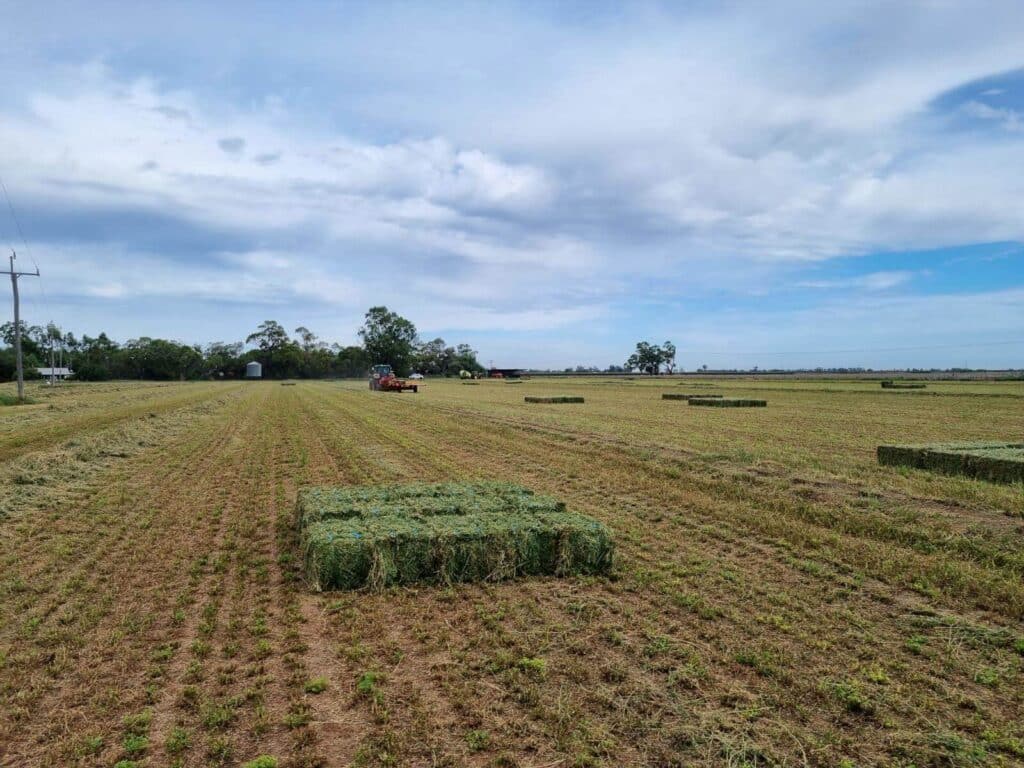
An Accumulator collects small square bales as they come off the baler and groups them into compact, uniform pack before dropping them in the paddock. This eliminates the need to pick up individual bales one at a time, dramatically reducing the number of trips and the amount of manual handling required.
For small square bale operations, an accumulator is often the first step toward productive mechanisation. It reduces labour at the most physically demanding point in the process: paddock collection.
If you’re currently running a crew to pick up individual small squares, an Accumulator will reduce that labour requirement significantly. The savings in wages and time across a season are considerable.
Small Bale Grabs
Small Bale Grabs allow a tractor or loader to handle multiple small square bales at once rather than moving them individually. They are a practical, cost-effective addition to any small bale operation and work well in combination with an accumulator.
Where Accumulators handle collection from the baler, Small Bale Grabs handle the loading, stacking and shed work. Together, they reduce the manual handling required at every stage of the process.
For smaller operations that aren’t ready to commit to a full stacking system, a grab is often the smartest starting point. Lower capital outlay, immediate labour savings and straightforward operation.
Vertical Stacking Systems
The Verti-Stack takes a different approach to bale stacking, building vertical stacks that maximise storage density and reduce the footprint required. These systems are particularly well-suited to operations where storage space is limited or where the stacking pattern needs to be consistent for transport or sale.
Vertical systems also reduce the physical effort required to build stable stacks, which becomes important on long days when fatigue is a factor.
Multi-Purpose Stacking Systems
The Unistack, our largest machine, is designed for operations that need high efficiency, larger loads, less travel and flexibility in handling different bale configurations or adapting to different paddock and storage setups. For contractors working across multiple properties with varying requirements, this kind of adaptability has real value.
Matching Equipment to Your Farm Size and Bale Type
There is no single right answer, the best equipment is the one that matches your specific situation. Here is a practical framework:
Small operations, small square bales: Start with a Small Bale Grab and an Accumulator. These two pieces of equipment together will dramatically reduce manual handling without a large capital outlay. They also work well with existing tractors and loaders in most cases.
Medium operations, mixed bale types: Look at a mid-range stacker. The focus here is on versatility. You need equipment that can handle variation in bale size, paddock conditions and storage requirements without constant reconfiguration.
Large operations and contractors: Volume and speed are the priorities. A high-capacity Big Bale Stacker, Verti-stack or Unistack, purpose-built for your bale size, is the right tool. At this scale, the return on investment is fastest because the machine is working harder and more consistently. Explore the full hay handling range to understand what’s available across different capacities.
The Labour Savings Are Real and They Add Up
The labour argument for mechanised bale handling is straightforward when you run the numbers.
Consider a medium-sized operation collecting and stacking 10,000 small square bales per season. Manual handling at that volume requires multiple workers over multiple days. Mechanised handling with the right equipment can reduce that to one or two operators in significantly less time.
The wage savings alone often cover the cost of the equipment within a few seasons. Beyond the direct cost, there are the indirect benefits: reduced dependence on seasonal labour availability, lower physical fatigue on the team, and the ability to move faster when a weather window opens.
Contractors benefit even more directly. Faster handling means more jobs completed per season, more clients serviced and a better return on every day of the season.
Safety Benefits That Are Easy to Overlook
Manual bale handling is physically hazardous. Lifting, stacking and moving heavy bales repeatedly leads to musculoskeletal injuries that are among the most common and costly in agriculture. These injuries don’t always show up immediately; they accumulate over seasons and can affect workers for years.
Mechanised handling removes the most physically demanding tasks from the equation. It reduces the number of people required in and around moving equipment. It creates a more structured, predictable workflow that is safer for everyone involved.
For farm businesses that employ staff, this also has implications for workers’ compensation and duty of care. Reducing manual handling exposure is not just good practice, it is increasingly a responsibility.