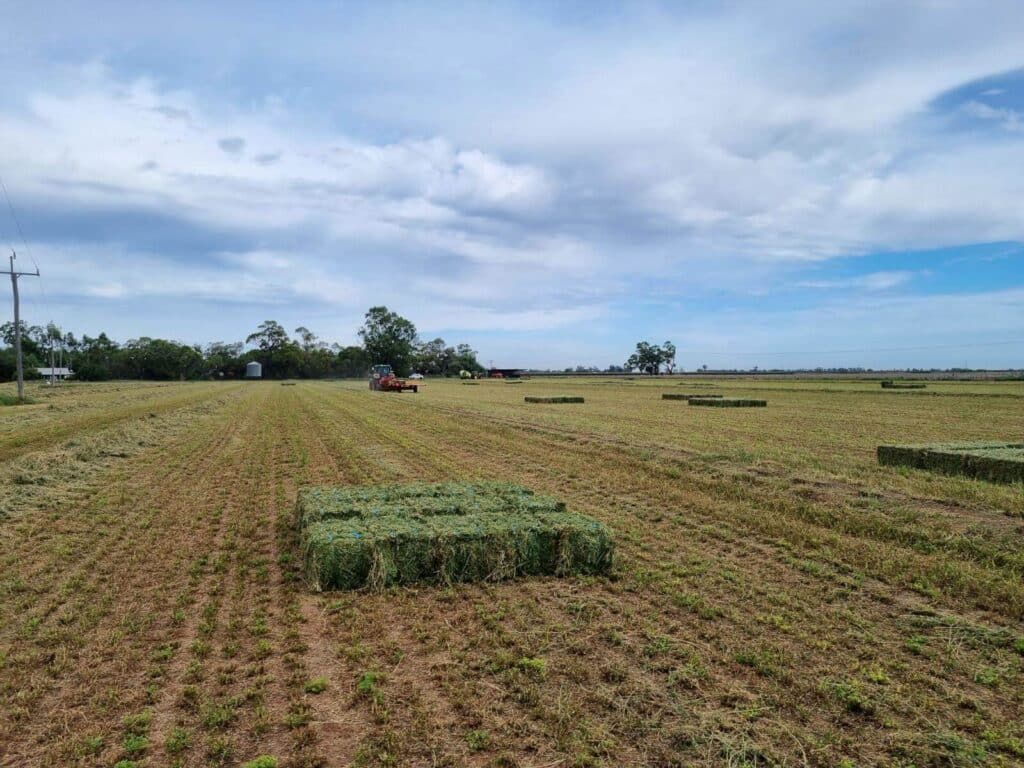
Lucerne leaf loss happens when dry leaves shatter and fall away from the stem during raking, baling, handling and storage. It matters because the leaf carries most of the crop’s protein, so every leaf left in the paddock takes feed value with it. Much of that loss comes down to timing and how many times each bale gets moved, both of which you can control.
If you’ve ever walked behind a bale trailer and seen green flakes on the ground, then you’ve seen it happen. This guide walks you through where the leaf goes and how to keep more of it.
Why is Lucerne Worth Protecting?
Lucerne (alfalfa) is a perennial legume grown for its high protein and calcium content. Good lucerne hay sells at a premium, especially into the horse and dairy markets. Buyers judge it on leafiness, colour, smell and feed test results, and they pay more for quality lucerne hay that scores well.
Growers fund that quality upfront by establishing a stand, then irrigating it and cutting and baling several times a season. That said, growing a good crop is only half the job. The other half is getting it to the buyer with the leaf still on. Every leaf that shatters off along the way takes some of that spend with it.
How Much of Lucerne’s Value is in the Leaf?
Most of it is in the leaf. The United Kingdom’s Agriculture and Horticulture Development Board (AHDB) puts it at up to 70% of the plant’s protein and 90% of its minerals and vitamins.
The problem is that leaves and stems don’t dry at the same rate. Agriculture Victoria explains that once lucerne drops below about 40% moisture, the thin leaves dry much faster than the stems. By the time the stems are ready to bale, the leaves can be dry enough to shatter.
A bale that loses leaf ends up stemmier, tests lower and looks worse. Not every lost leaf has a fixed dollar value, because returns also depend on feed tests, contracts and the market. But it’s a quality loss you can do something about.
Where Does Lucerne Lose Leaf?
Lucerne can lose leaf at any stage between the windrow and the shed.
- Raking: Agriculture Victoria says as much as 15% of dry matter can be lost if growers rake legumes like lucerne at the wrong time.
- Baling: hay that goes into the baler too dry has brittle leaves that shatter in the pickup and chamber.
- Paddock collection: every time someone picks up or drops a bale, more leaves come off.
- Loading and transport: dragging bales, rough transfers and unstable loads all add damage.
- Stacking and restacking: every extra move is another chance for leaves to shatter.
- Storage: rain, sun and poor storage can damage colour and feed quality, on top of any leaf already lost.
What Else Does Lucerne Leaf Loss Cost?
The leaf on the ground is only part of it. Leaf loss can also mean a lower grade, more time handling bales, and more labour and machinery hours.
Those costs stack up when the same bales get moved several times between the paddock, the trailer and the shed. The more times you touch a bale, the more chances there are to lose leaf, and the longer the hay sits exposed to the weather.
How Can You Reduce Lucerne Leaf Loss?
- Rake with some moisture in the leaf. Agriculture Victoria recommends raking above 30% moisture, ideally early in the morning or late in the evening when the leaves have picked up moisture from the air.
- Bale at the right moisture for your bale type. Agriculture Victoria also recommends 16 to 18% for small squares, 14 to 16% for large rounds and 12 to 14% for large squares. Too dry and you lose leaf. Too wet and the hay can heat, go mouldy or catch fire. Our baling moisture guide covers this in more detail.
- Handle each lucerne bale fewer times. Plan the route from baler to shed so there are fewer lifts, drops and restacks.
- Move bales in packs, not one at a time. For small squares, collecting bales into packs and lifting the whole pack means far fewer individual lifts.
- Use gear that suits your bales. Match your grab, accumulator or stacker to your bale size, weight and conditions, and avoid dragging or dropping bales.
- Get it under cover and keep an eye on it. Store hay out of the weather with good airflow. Agriculture Victoria advises watching stacks for signs of heating, like damp bale tops or steam. See how to store square bales for more.
How are Lucerne Growers Handling Bales with Less Damage?
We started out as farmers ourselves, so we know what it’s like to watch good hay get knocked around between the paddock and the shed. Lorin and Oakley’s father, David Wallace, and his brothers built Jadan’s first accumulator in 1989 and started the business in 1990 on the farm near Canowindra. We’ve been building hay handling gear in the Cowra district ever since, now from our workshop in Cowra.
Greg Damiani, who grows premium lucerne for the horse market at Gawler River in South Australia, used to stack every small square bale by hand before buying a Jadan Small Bale Accumulator.
“We were hand stacking before purchasing the Jadan 15-bale accumulator, so let’s just say it’s our favourite machine.” Greg Damiani, Gawler River
Since the purchase, Greg has been able to grow four times more lucerne and still get it stacked and into the shed ahead of the weather. Read Greg’s story.
On the Bell River near Wellington, irrigated lucerne grower Michael Horton was relying on several workers and a lot of heavy lifting to keep up through summer. With an accumulator and grab, the same team now gets more done with far less manual handling. Read Michael’s story.
Here’s what we build for each bale type:
- Small square bales: the Small Bale Accumulator collects 15 bales into a pack behind the baler, and the Small Bale Grab lifts the whole pack onto a truck or into the shed.
- Large square bales: the Verti-Stack 1200, Big Bale Stacker and Unistack® T140 collect and stack bales with fewer separate movements.
No machine can save leaf you’ve already lost to bad timing at the rake or the baler. What the right gear does is cut down the number of times each bale gets handled after that. If you’re not sure where to start, we walk through the options in this quick Bale Handling 101.

Protect the Value You’ve Already Grown
Premium lucerne starts with a good crop, but it doesn’t end at the baler. Raking and baling at the right moisture, handling each lucerne bale fewer times and getting it under cover quickly all help keep the leaf where it belongs.
If you’d like to talk through a setup that suits your bales and your operation, call us on 1300 523 263, explore our website or find your nearest dealer.